Plan the Annapurna Base Camp Trek in 2026/27: route, day-by-day itinerary, permits, difficulty and costs. Honest guide from Trekking Guide Team Adventure.
Annapurna Base Camp Trek via Poon Hill - 9 days
Pokhara
FromUS$625US$675

Plan the Annapurna Base Camp Trek in 2026/27: route, day-by-day itinerary, permits, difficulty and costs. Honest guide from Trekking Guide Team Adventure.
✔ Verified by Our Trek Leaders
This guide is written by the licensed guides and trek leaders at Trekking Guide Team Adventure, a TAAN-registered operator based in Kathmandu. Our teams escort groups to Annapurna Base Camp year-round. The difficulty assessments, walking times, and altitude figures in this article reflect direct field experience on the route, not secondary sources.
The Annapurna Base Camp Trek reaches 4,130m at the floor of a glacial sanctuary enclosed on three sides by peaks above 7,000m. Annapurna I (8,091m), Annapurna South (7,219m), Hiunchuli (6,441m), and Machapuchhre (6,993m) surround the base camp on three sides. On our 9-day itinerary from Pokhara, the approach via Poon Hill takes 6 days and the descent takes 3. It is one of the most complete trekking experiences in the Annapurna region and one of the few routes in Nepal where the destination - the base camp area itself - fully justifies every day of walking to reach it.
This guide covers the full route, a day-by-day itinerary, the real difficulty, current permits and costs, and answers to the questions trekkers consistently ask before booking.
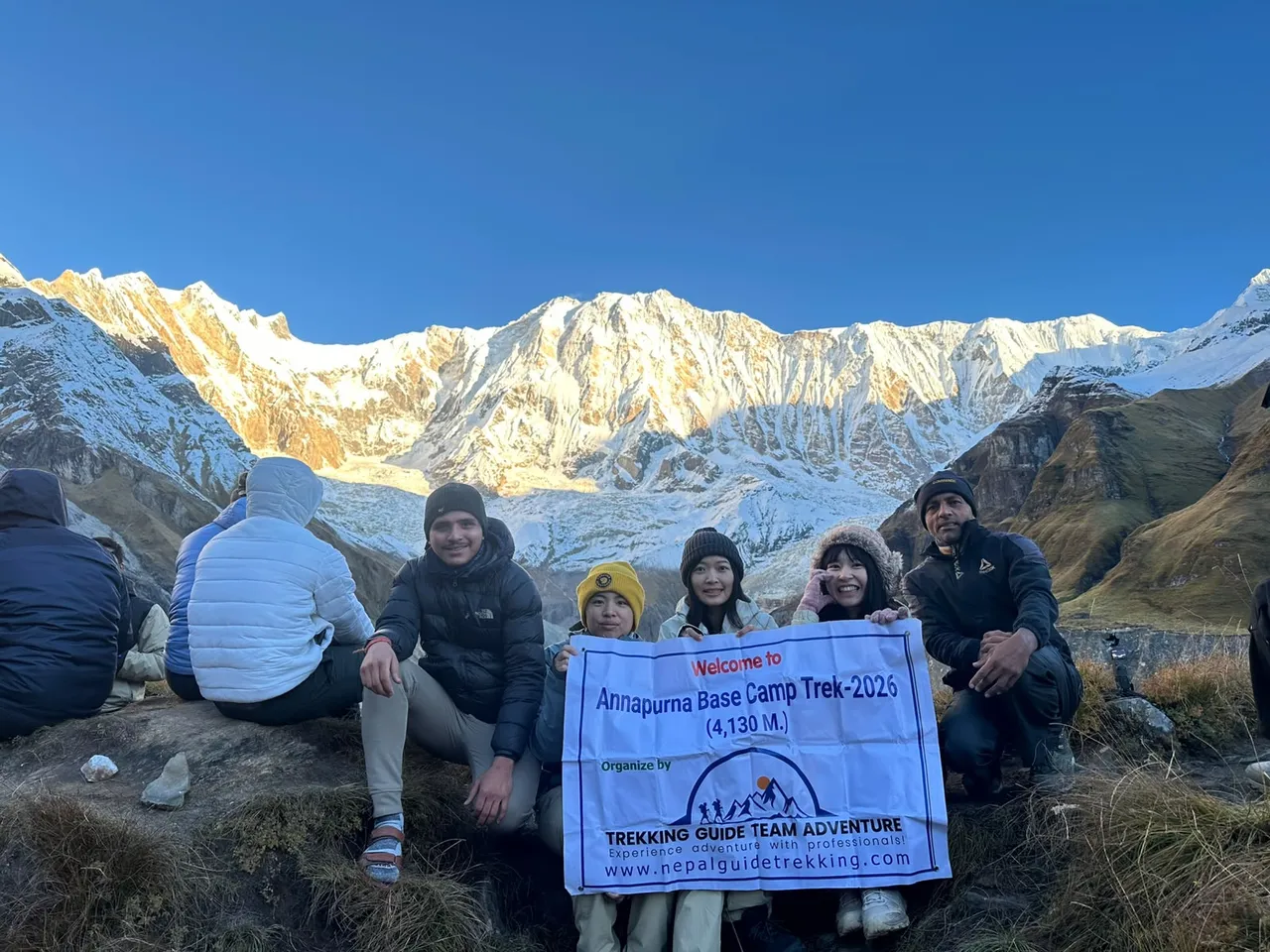
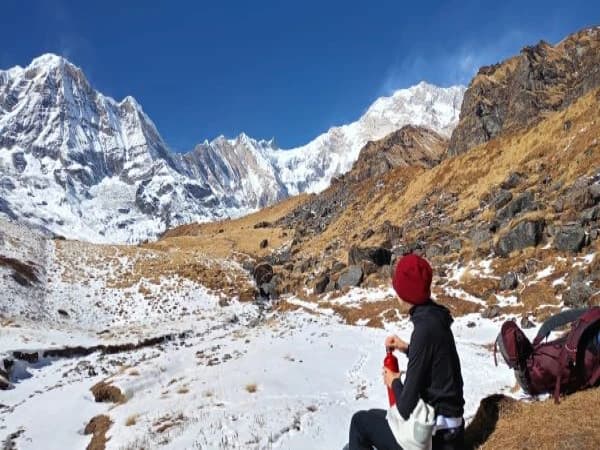
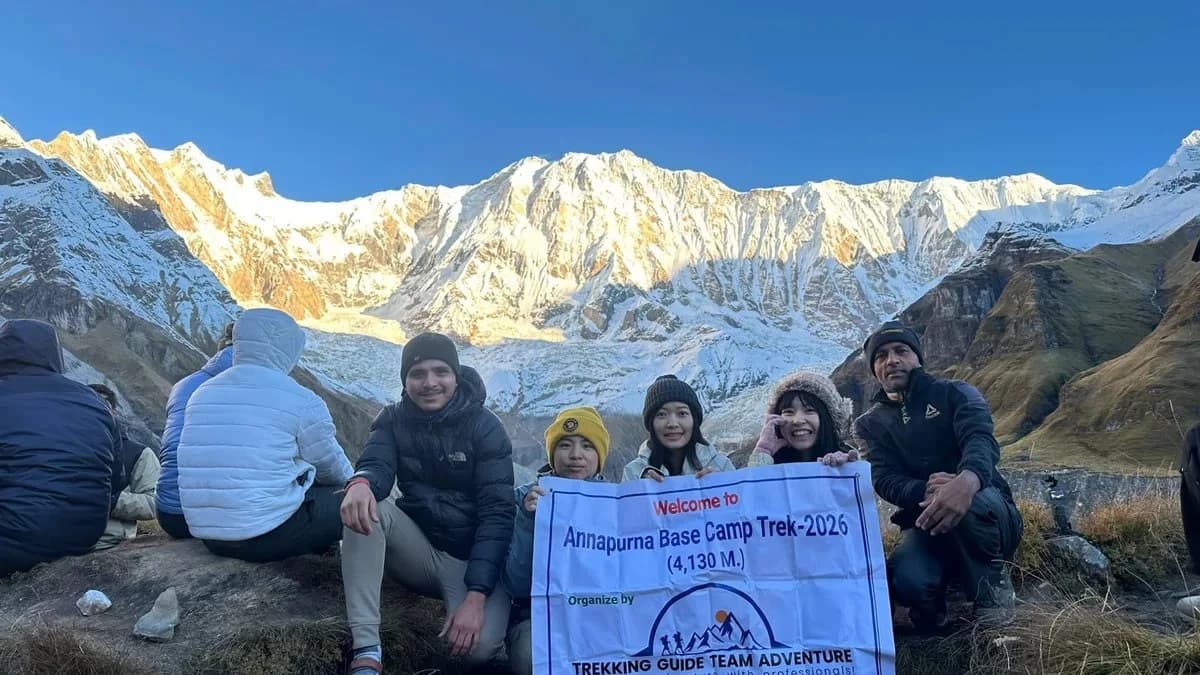
Our trekking group at Annapurna Base Camp (4,130m) at sunrise, with the Annapurna massif behind
The Annapurna Base Camp Trek (ABC Trek) follows the Modi Khola river northward from the Pokhara foothills through subtropical forest, terraced farmland, rhododendron forest, and progressively higher alpine terrain. The route passes through a series of Gurung villages - Ghandruk, Chhomrong, Sinuwa, Bamboo, Deurali - before entering the Annapurna Conservation Area through a narrow gorge. The gorge walls above Deurali (3,230m) reach over 5,000m on both sides. It is one of the most visually dramatic approach sections on any trekking route in Nepal.
The sanctuary itself is a high mountain bowl: a bowl of moraine, snow, and ice at 4,130m surrounded by the Annapurna massif and the Machapuchhre ridge. Arriving at Annapurna Base Camp after 6 days of walking through the gorge and the lower forest is a specific experience that photographs do not fully prepare trekkers for.
On the standard 10-day itinerary, the trekking section begins on Day 3 with a drive from Pokhara to Syauli Bazar (1,170m), followed by a walk up to Chhomrong (2,170m) via Jhinu Danda (1,780m). Day 4 continues from Chhomrong through Sinuwa and Bamboo to the Himalaya Hotel area (2,920m). Day 5 is the big day: from Himalaya to Annapurna Base Camp (4,130m) via Machapuchhre Base Camp (3,700m). The descent retraces the route through Bamboo and Sinuwa, then branches off via Landruk to Tolka on Day 7, before walking out to Dhampus Phedi (1,050m) on Day 8 for the drive back to Pokhara.
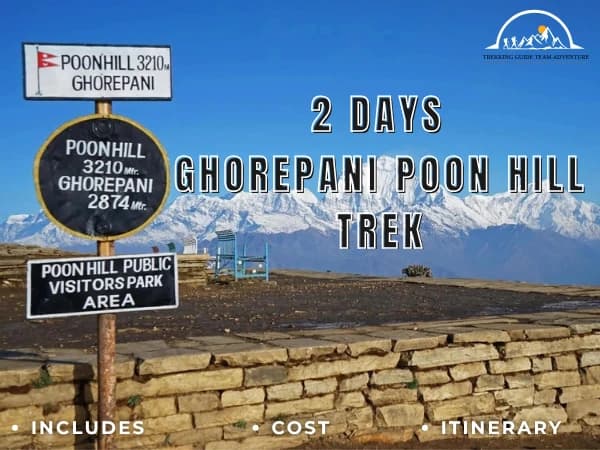
Trekkers who want to combine Annapurna Base Camp with the Poon Hill sunrise viewpoint (3,210m) at Ghorepani can do so on longer itineraries: the 9-day, 13-day, and 15-day via Poon Hill variants. These routes add the Tikhedhunga-Ulleri-Ghorepani approach and the pre-dawn Poon Hill hike before continuing to Chhomrong and the base camp. The day-by-day itinerary below follows the 9-day version, Pokhara to Pokhara. The 10-day standard package does not include Ghorepani or Poon Hill. If you only want the sunrise viewpoint, see the Ghorepani Poon Hill Trek from Pokhara (2 Days).
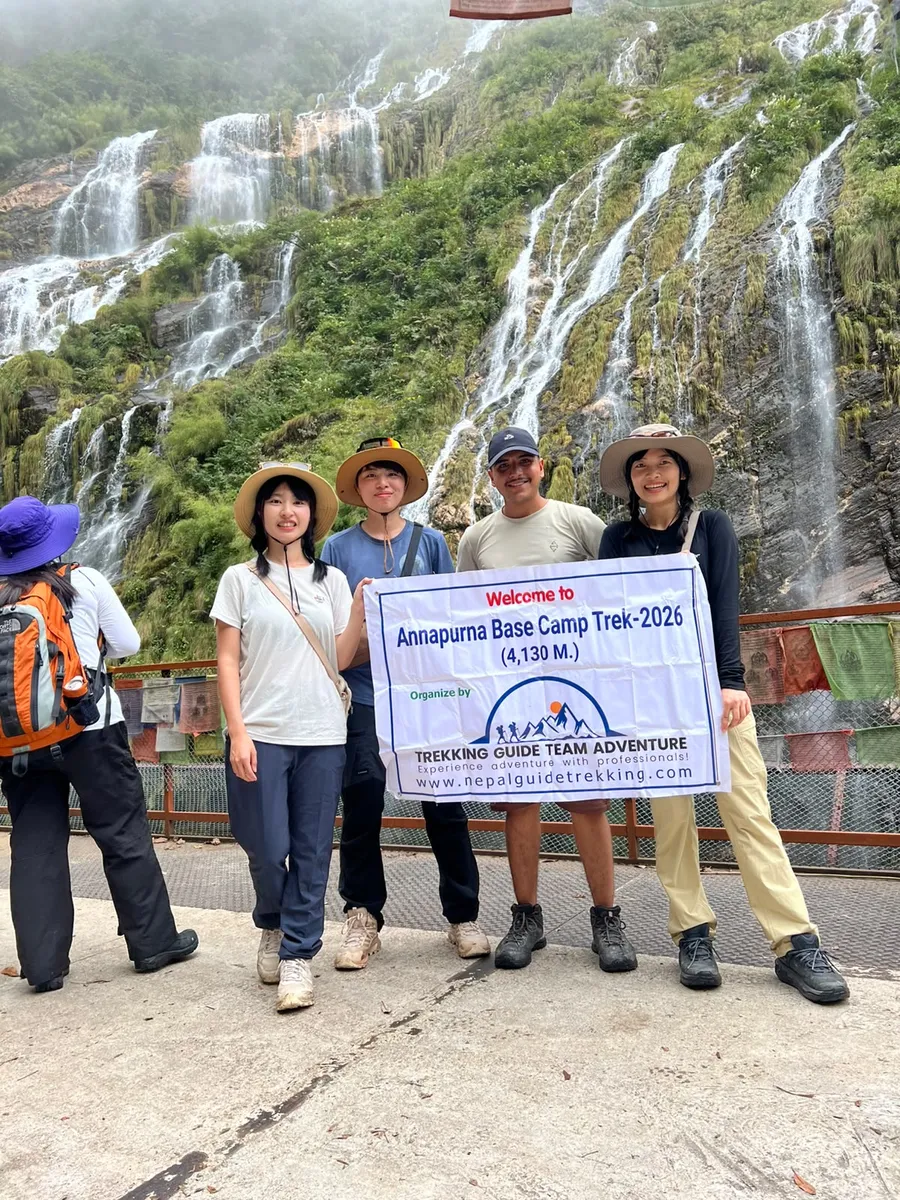
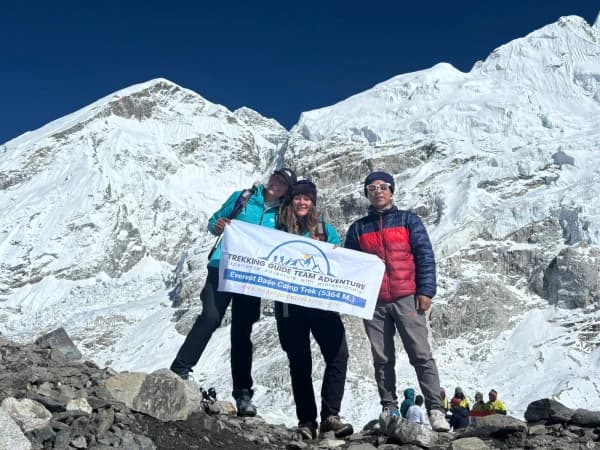
A Trekking Guide Team Adventure group on the trail during the Annapurna Base Camp Trek
| Day | Section | Altitude | Walking Time |
|---|---|---|---|
| Day 1 | Drive Pokhara to Birethanti, trek to Ulleri | 2,050m | 1.5 hours drive, 5 to 6 hours walking - stone staircase section |
| Day 2 | Ulleri to Ghorepani | 2,860m | 4 to 5 hours, steady climb through forest |
| Day 3 | Pre-dawn Poon Hill (3,210m), trek to Tadapani | 2,650m | 6 to 7 hours total including Poon Hill |
| Day 4 | Tadapani to Chhomrong | 2,170m | 4 to 5 hours through rhododendron forest |
| Day 5 | Chhomrong to Himalaya via Sinuwa and Bamboo | 2,920m | 6 to 7 hours - descent then long ascent |
| Day 6 | Himalaya to Annapurna Base Camp via Deurali and MBC | 4,130m | 6 to 7 hours - 1,210m ascent; sanctuary opens above MBC (3,700m) |
| Day 7 | ABC - morning at the base camp area, descent to Bamboo | 2,310m | 6 to 7 hours descending |
| Day 8 | Bamboo to Jhinu Danda, optional hot spring | 1,780m | 5 to 6 hours, hot spring in afternoon |
| Day 9 | Jhinu Danda to Pokhara by local shared jeep | 820m / Pokhara | 3 to 4 hours by jeep |
Guided departure dates and pricing for this itinerary: see Annapurna Base Camp Trek via Poon Hill (9 Days). Prefer the direct route? See Annapurna Base Camp Trekking (10 Days).
The ABC trek is rated moderate. It is harder than Ghorepani Poon Hill but easier overall than the EBC trek, because it reaches a lower maximum altitude (4,130m vs 5,364m at EBC) and spends fewer nights above 3,500m. There is no technical terrain. "Moderate" does not mean easy, though: three sections account for most of the effort, and Day 6 is the hardest day of the trek.
Mild AMS symptoms above 3,500m are normal and expected - headache, reduced appetite, disrupted sleep. The standard protocol is to rest at altitude rather than descend immediately. If symptoms worsen with rest or include loss of coordination, descent to below 3,000m is required. The Himalayan Rescue Association maintains posts in the Annapurna region during trekking season.
Looking for a shorter, less crowded alternative in the same region? Read our Mardi Himal Trek difficulty guide.
| Permit | Cost 2026/27 | Where to Obtain | Checkpoint |
|---|---|---|---|
| ACAP (Annapurna Conservation Area Permit) | NPR 3,390 (approx. USD 25) | Nepal Tourism Board Pokhara or Kathmandu; or through your operator | Nayapul or Birethanti entry gate |
| Mandatory Licensed Guide | Cost included in guided package | TAAN-registered operator only | Guide carries their NTB licence card |
For a full breakdown of permits across every Nepal trekking region, see our trekking permit fees page.
A guided 10-day ABC package from a mid-range Kathmandu or Pokhara operator costs approximately:
A standard package includes guide, porter (one per two trekkers), all accommodation and meals on trail, ACAP permit, and Pokhara transfers. It does not include personal gear, travel insurance, tips, or personal extras on trail.
Daily on-trail extras (hot drinks, wifi, showers) run USD 10 to USD 25 per day above Chhomrong. Tips for guide and porter are standard: USD 15 to USD 20 per day for the guide, USD 8 to USD 12 for the porter, across 10 days.
October is the single best month for the Annapurna Base Camp Trek. The monsoon ends in late September, leaving the trails dry and the skies clear. Morning views of Machapuchhre (6,993m) and the Annapurna range from above Chhomrong and at the base camp are at their most consistent. Daytime temperatures at Chhomrong (2,170m): 12 to 18 degrees Celsius. Overnight at the base camp (4,130m): minus 2 to minus 8 degrees Celsius. A sleeping bag rated to minus 10 degrees Celsius and a down jacket are required from Deurali upward.
November remains reliable for the first two weeks. From mid-November, overnight temperatures at the base camp drop to minus 10 to minus 15 degrees Celsius and the gorge approach above Deurali begins to carry ice on the stone steps. Walking times increase. The trail is still passable but requires more caution on the descent.
Spring is the second recommended season. The rhododendron forests between Tikhedhunga and Ghorepani are in full bloom from late March through April - the lower approach section between 1,500m and 3,000m is covered in red, pink, and white flowers. Daytime temperatures at the base camp in March and April: 2 to 10 degrees Celsius. Overnight: minus 4 to minus 10 degrees Celsius.
The trade-off in spring is visibility. From mid-April onward, afternoon cloud builds across the Annapurna massif from around 11am to 2pm. Mornings at the base camp are still clear on most days. The reliable window for the full mountain view at ABC shifts earlier in the day compared to October. Plan to be at the base camp by 7am to 8am for the clearest conditions.
March from mid-month is reliable. Early March can carry residual winter snow on the steps above Ghorepani and on the gorge approach. Confirm trail conditions before a departure before March 15.
The ABC route does not formally close in winter but conditions above Deurali (3,230m) become genuinely difficult. Snow and ice on the stone steps between Himalaya Hotel and the base camp make the ascent and descent slow and risky without crampons. The gorge walls above Deurali channel wind and cold in a way that makes even short sections uncomfortable. Teahouse availability reduces significantly - some close entirely between December and February. Not recommended for standard trekking groups.
The Annapurna region receives some of the heaviest monsoon rainfall in Nepal. The trail below Chhomrong becomes muddy, slippery, and heavily leeched from June to September. Above Deurali, the narrow gorge approach channels rain runoff and creates rockfall and small landslide risk on the walls above the trail. The base camp is under cloud on most days. Visibility at the base camp during monsoon is near zero. Do not attempt the Annapurna Base Camp Trek during monsoon season.
Most trekkers arrive at Annapurna Base Camp in the afternoon and spend the night before descending the next morning. The sanctuary in afternoon light is dramatic but cloud often builds by 2pm. The reliable window for the full horseshoe view is early morning - from approximately 6am to 9am, before thermal cloud development.
At 4,130m, overnight temperatures in October range from minus 2 to minus 8 degrees Celsius, dropping further from mid-November. The teahouses at ABC are permanent structures with heated dining rooms but unheated sleeping rooms. A sleeping bag rated to minus 10 degrees is the minimum. The toilets are outside. Water at ABC comes from melted glacier runoff and requires purification.
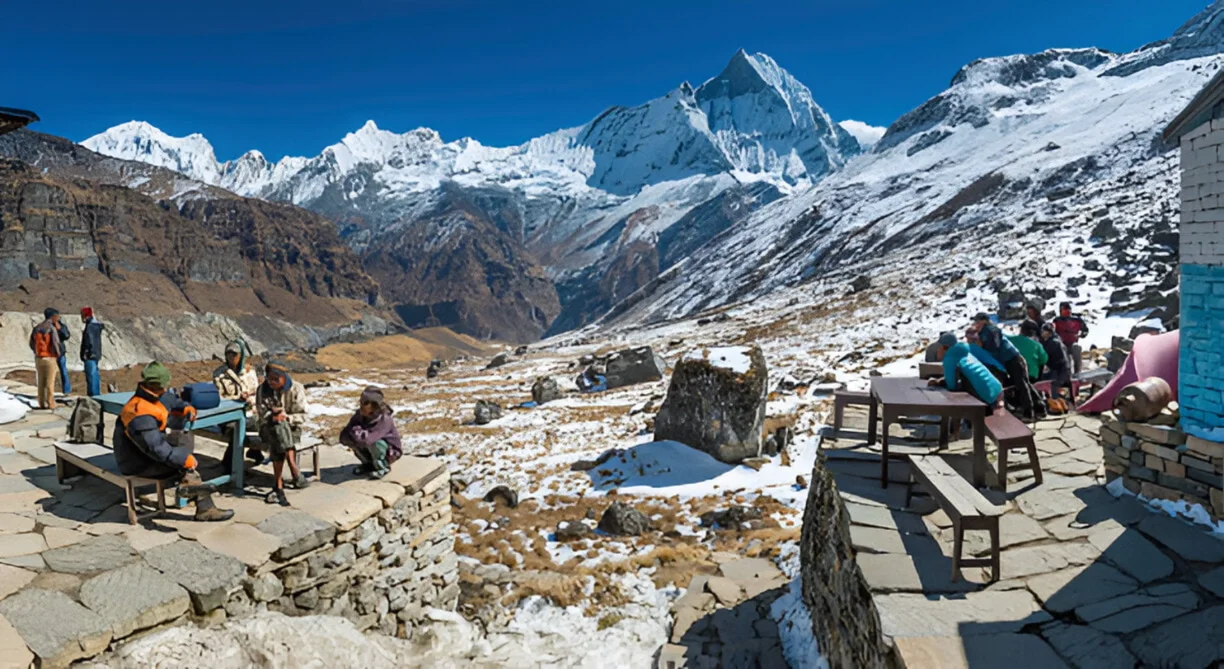
The teahouse terrace at Annapurna Base Camp, with Machapuchhre (Fishtail) on the skyline
The Machapuchhre (Fishtail) peak is visible throughout the approach from Chhomrong onward, changing shape as the angle of approach shifts. At ABC, it stands directly above the base camp area to the southeast. Climbing Machapuchhre is not permitted - it is considered sacred and has been closed to climbers since 1957.
Moderate. There is no technical terrain, and the trek is suitable for first-time trekkers with basic hiking fitness and no prior altitude experience. Three sections are demanding: the stone staircase from Tikhedhunga to Ulleri on Day 1 (around 3,300 steps), the steep descent and re-ascent from Chhomrong to Sinuwa on Day 5, and Day 6, the 1,210m climb from Himalaya (2,920m) to Annapurna Base Camp (4,130m) via Machapuchhre Base Camp. Day 6 is the hardest day of the trek because of the combination of elevation gain and altitude.
Nine days from Pokhara on our via Poon Hill itinerary: 6 days up to the base camp, 2 days down to Jhinu Danda, and a shared jeep back to Pokhara on Day 9. Add a day at each end if you are travelling from Kathmandu. A shorter direct route via Chhomrong skips Ghorepani and Poon Hill, and longer 13-day and 15-day variants are also available.
One permit: the ACAP (Annapurna Conservation Area Permit) at NPR 3,390 per person. TIMS is not required in 2026/27 for trekkers with a licensed guide. A mandatory licensed guide from a TAAN-registered agency is required by law for all foreign trekkers in the Annapurna Conservation Area.
October is the best single month. Post-monsoon clear skies, dry trail from Nayapul to ABC, and the gorge approach above Deurali at its safest. November is also good but colder. March and April are the spring alternative with rhododendron bloom below 3,000m and slightly less predictable visibility at the base camp area.
The two routes are comparable in daily effort. ABC has a steeper approach on some days (particularly the Ulleri stone staircase and the Chhomrong descent-ascent section) but reaches a lower maximum altitude (4,130m vs 5,364m at Kala Patthar). EBC is harder overall due to the higher altitude sustained over more days. ABC is the appropriate choice for trekkers who want a high-mountain sanctuary experience at a manageable altitude for a first Nepal trek.
.webp&w=1200&q=75&dpl=dpl_E7WFSfpfFarQhQrrUmYZuK17D6bV)