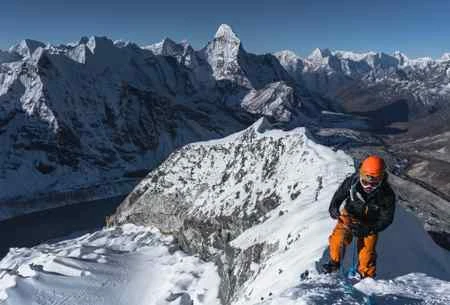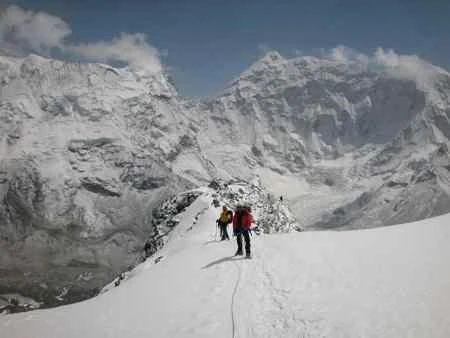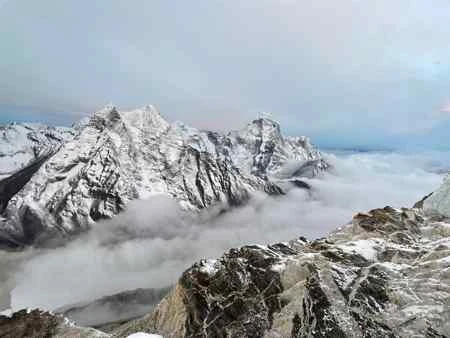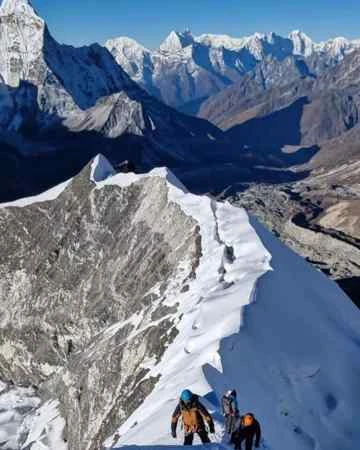
Island Peak Climbing from Chhukung
Island Peak (Imja Tse) stands at 6,189m in the Khumbu region. The three-day climbing programme from Chhukung (4,730m) is a technical high-altitude climb - crampons, ice axe, harness, and fixed ropes are all required on a glacier route that steepens considerably above High Camp. The summit gives a wide view across the Khumbu, with Lhotse, Nuptse, Makalu, Ama Dablam, and Cho Oyu all visible on a clear morning.
This programme is for trekkers already acclimatised in the Khumbu - ideally coming off an EBC trek or the Three Passes route. That prior acclimatisation is not a bonus. It is the foundation on which the three-day schedule is built. The page covers who the climb suits, what the route involves, and what the three days look like.
Quick Trip Facts
|
Detail |
Information |
|
Peak |
Island Peak (Imja Tse) |
|
Summit Altitude |
6,189m / 20,305 feet |
|
Starting Point |
Chhukung (4,730m), Khumbu Region |
|
Ending Point |
Chhukung (4,730m) |
|
Duration |
3 Days from Chhukung |
|
Base Camp Altitude |
Approx. 5,100 to 5,200m |
|
High Camp Altitude |
Approx. 5,600m |
|
Difficulty |
Strenuous - technical high-altitude climbing |
|
Technical Grade |
PD (Alpine grading) - glacier travel, fixed ropes, 40 to 60-degree slopes |
|
Climbing Experience |
Basic mountaineering skills required - training provided on Day 2 |
|
Best Season |
October to November / March to May |
|
Accommodation |
Teahouse in Chhukung, tented camp at Base Camp and High Camp |
|
Group Size |
1 to 10 persons |
|
Guide |
NMA-licensed climbing guide throughout |
|
Summit Day |
12 to 16 hours total including descent |
Highlights
-
Summit Island Peak (Imja Tse) at 6,189m - the most accessible 6,000m technical peak in the Khumbu region and one of Nepal's most popular trekking peaks
-
Start from Chhukung (4,730m), already deep in the Khumbu - no redundant approach trekking for those who have completed EBC or the Three Passes route
-
Glacier travel on the Imja Glacier above High Camp, with fixed ropes on the steepest sections approaching the summit ridge
-
Pre-dawn summit push with Ama Dablam, Lhotse, and Baruntse lit by first light as you gain the summit ridge
-
Summit panorama across six 8,000m peaks - Everest, Lhotse, Makalu, Cho Oyu, Kangchenjunga on clear days, with the full sweep of the Imja Valley and Island Peak Glacier below
-
NMA-licensed climbing guide, all technical equipment, and structured pre-summit training included
-
Natural combination with Everest Base Camp, Gokyo Lakes, or the Everest Three Passes route - all of which pass through Chhukung
Island Peak Climbing from Chhukung: Overview
Island Peak got its name from Eric Shipton's 1952 British reconnaissance expedition, which described the peak as appearing like an island of rock and ice rising from the surrounding glaciers when viewed from the Dingboche valley. The name has stayed, though the Nepali designation - Imja Tse - now appears equally on permit documents and on the peak itself. At 6,189m, it sits at the upper boundary of Nepal's trekking peaks category, and it occupies a specific position in the Himalayan climbing landscape: genuinely technical, genuinely high, but accessible to trekkers who are prepared and properly acclimatised.
The three-day programme from Chhukung compresses a longer approach into a tightly structured summit schedule. Day 1 is preparation in Chhukung - equipment inspection, guide briefing, and gear fitting. Day 2 moves to Island Peak Base Camp (5,100 to 5,200m), where the afternoon is used for crampon walking, ice axe handling, harness fitting, and fixed-rope technique practice on the moraine above camp. Day 3 is the summit day: departure between midnight and 2am, High Camp passage, glacier crossing, the fixed-rope section, and the summit by mid-morning if conditions allow, followed by descent to Base Camp and then back to Chhukung.
The reason this compressed schedule works - when it works - is acclimatisation. The Imja Valley approach to Chhukung takes most trekkers through Namche Bazaar (3,440m), Dingboche (4,360m), and several nights at altitude before arriving at Chhukung (4,730m). By the time someone begins the Island Peak programme, their blood oxygen chemistry has been adapting for days. The climb itself does not begin the acclimatisation process - it depends on it already being established.
Technically, Island Peak is graded PD (Peu Difficile) in Alpine grading. That places it above a walking route (F grade) and into genuinely technical terrain. The glacier approach above High Camp involves a 40 to 60-degree snow and ice slope, and the summit ridge requires fixed-rope technique and careful movement on exposed terrain. The summit day typically runs 12 to 16 hours from Base Camp, depending on conditions, group pace, and weather. It is not a casual high-altitude walk. The combination of sustained physical output, altitude above 6,000m, technical terrain, darkness, and cold makes the Island Peak summit one of the more demanding days available on a Khumbu itinerary.
For the right candidate - someone who has spent time in the Khumbu, trained appropriately, is comfortable with altitude, and has a clear understanding of what the technical sections demand - Island Peak from Chhukung is one of the most complete Himalayan experiences available in a short departure window. For someone under-prepared or inadequately acclimatised, it carries real risk. The sections that follow explain the route, the requirements, and what to expect on each of the three days.
Why Climb Island Peak from Chhukung?
Chhukung sits at 4,730m at the end of the Imja Valley, a direct approach corridor toward Island Peak Base Camp. The walk from Chhukung to Base Camp (5,100 to 5,200m) takes approximately 3 to 4 hours on a well-defined trail through glacier moraine and alpine terrain. The logical proximity - combined with the fact that most Khumbu trekking itineraries pass through Chhukung or very close to it - makes this the natural departure point for Island Peak climbing programmes.
The operational advantage is time. A trekker completing the Everest Base Camp route arrives at Chhukung after multiple nights at altitude, including nights at Dingboche (4,360m) and Lobuche (4,940m), with two acclimatisation days typically built in. They arrive at Chhukung with physiology already calibrated to altitude. Starting the Island Peak programme here requires no additional approach trekking - the acclimatisation has been done. Extending from EBC to Island Peak from Chhukung adds three focused climbing days to a Khumbu itinerary rather than requiring a separate trip.
The same logic applies to Everest Three Passes trekkers, whose route passes directly through Chhukung. After crossing Kongma La (5,535m) and spending time above 5,000m, they are arguably better acclimatised for Island Peak than most other approaches allow.
What Chhukung as a starting point does not provide: additional acclimatisation. The three days from Chhukung do not build altitude tolerance - they assume it. Someone who has just arrived in the Khumbu and pushes to Chhukung quickly to attempt Island Peak without adequate prior altitude exposure is not a good candidate for this programme. The short duration is not a shortcut. It is a framework that only functions correctly when the foundational acclimatisation has already taken place.
Island Peak Climbing Itinerary from Chhukung - 3 Days
The itinerary below assumes the climber arrives in Chhukung already acclimatised - typically as part of an Everest Base Camp trek, Everest Three Passes route, or equivalent Khumbu itinerary.
Day 1 - Chhukung: Arrival, Equipment Check, Briefing
|
Altitude |
Chhukung 4,730m |
|
Activity |
Equipment check, briefing, rest |
|
Accommodation |
Teahouse, Chhukung |
|
Meals |
Not included - arrange in Chhukung teahouse |
The guide meets the group in Chhukung for a full briefing covering the route, technical sections, summit-day protocol, and current weather considerations. All personal equipment is inspected and adjusted - boots checked with crampons, harness sizing confirmed, ice axe positions set.
The afternoon is for rest and altitude adjustment. An optional short walk toward Chhukung Ri helps with altitude exposure without the cost of a full trekking day. In the evening the guide reviews summit-day departure time, the route to Base Camp, and what to expect on the glacier above.
Day 2 - Chhukung to Island Peak Base Camp: Trek and Technical Training
-
Start: Chhukung 4,730m
-
Destination: Island Peak Base Camp - approximately 5,100 to 5,200m
-
Distance: Approximately 6 to 7km
-
Walking: 3 to 4 hours
-
Accommodation: Tented camp at Base Camp
-
Meals: Breakfast, lunch, and dinner included
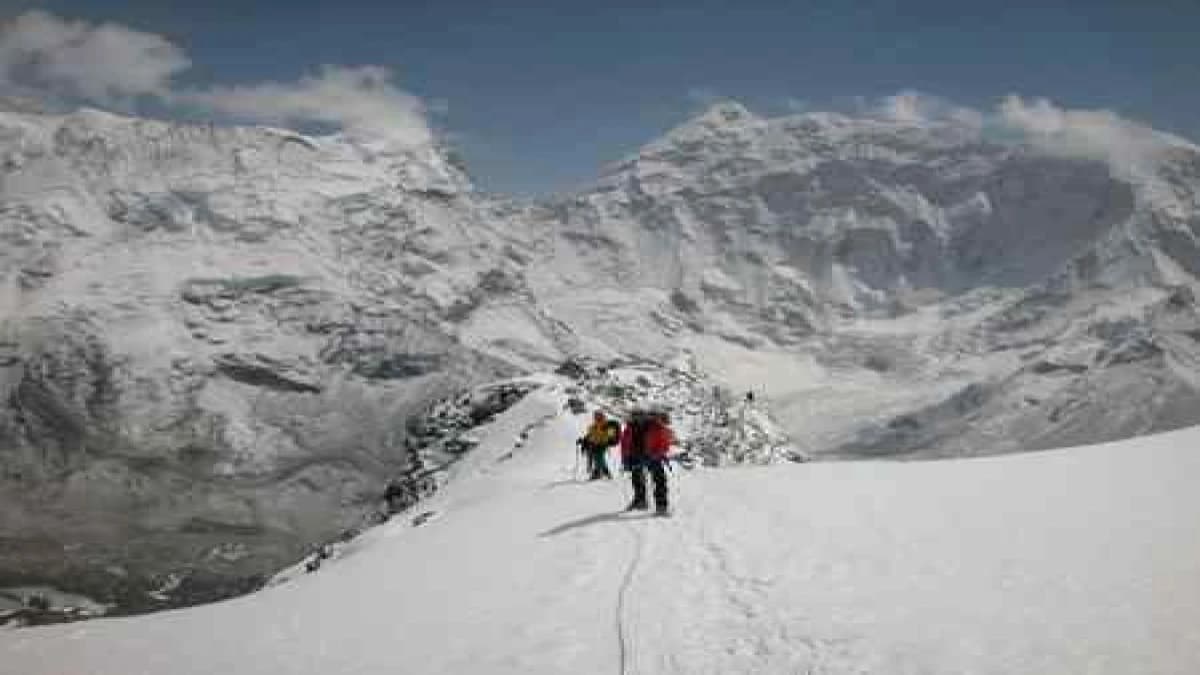
The trail leaves Chhukung after breakfast and heads southeast into the Imja Valley. For the first hour it is open and clean - a clear path across the valley floor with the morning light on the peaks above. Then the character shifts. The ground hardens under foot, the trail begins to rise, and glacier moraine replaces the grass and gravel of the lower valley. Lhotse (8,516m) fills the space directly ahead. Ama Dablam (6,812m) holds the northwest horizon. Baruntse (7,129m) closes the view to the east. At this proximity these are not background features - they define the scale of everything around them.
The trail continues across moraine and then follows the edge of the Imja Glacier as it rises toward the Base Camp shelf. The ground is rough and uneven in places but the route is clear. The elevation gain from Chhukung to Base Camp is gradual enough that most trekkers feel the altitude before they feel the gradient - a slight heaviness in the legs, a breath that takes a little more effort than it should. These are normal signals at 5,000m and above. The pace adjusts accordingly.
Island Peak Base Camp sits on a flat shelf of rock and moraine at 5,100 to 5,200m. The glacier above is visible, and above that the summit ridge draws a clear line against the sky. Tents are pitched and lunch comes out before the afternoon training session begins.
The guide leads the group to a slope above camp. Crampons, ice axes, harnesses, and a short section of fixed rope. Crampon technique is first - flat-footing on lower-angle ground, front-pointing on the steeper sections above. The ice axe comes next: self-arrest position, plunging technique, using it as a third contact point on steeper ground. Then the ascender on the rope: how it loads, how it moves, how to weight it properly, and how to reverse it for a controlled descent. The training is direct and specific. An afternoon on a practice slope does not replace years of mountaineering experience - but it covers exactly what tomorrow requires, in the light, with the guide watching and correcting technique before it matters.
Dinner is early - 5pm or 6pm. The guide runs a final briefing over the meal: departure time, the line from Base Camp to High Camp in the dark, the transition onto the glacier, and how the group moves through the fixed-rope section. Questions get answered now, not on the slope at 3am. Then to bed. Most people do not sleep deeply above 5,000m the night before a summit attempt, but the hours in a sleeping bag matter regardless.
Day 3 - Summit Day: Base Camp to High Camp to Island Peak (6,189m) and Return to Chhukung
-
Departure: Midnight to 2am from Base Camp
-
High Camp: Approximately 5,600m
-
Summit: Island Peak / Imja Tse - 6,189m
-
Total output: 12 to 16 hours including full descent
-
Return: Chhukung 4,730m
-
Meals: Pre-summit breakfast and packed food only - no dinner
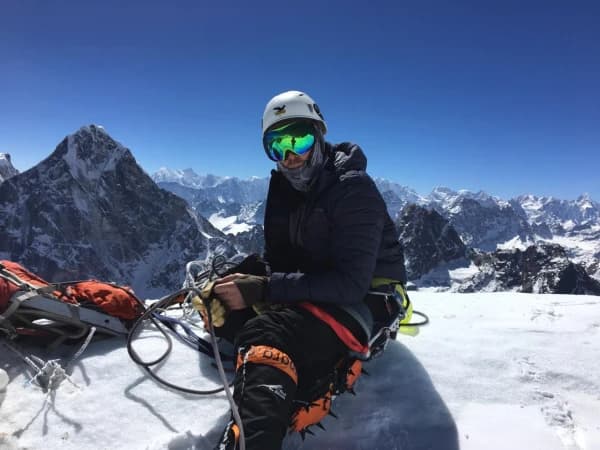
The alarm at midnight feels like it arrives before sleep did. The camp comes to life by headlamp: boots pulled on in the cold, crampons clicked into place, harnesses fitted over insulated layers. Temperatures sit somewhere between minus 10 and minus 20 depending on the wind. A hot drink, a final equipment check, and the group moves.
The first section from Base Camp to High Camp (5,600m) is steep and loose in the dark - glacier moraine underfoot, headlamps the only reference. The pace is controlled. At this altitude burning reserves on the first two hours of a twelve-hour day is a mistake that does not correct itself later. The guide holds the tempo, and the group follows. High Camp comes up after two to three hours: a brief stop, packs checked, conditions assessed.
Above High Camp the ground changes. Moraine gives way to snow, then ice, and the angle asserts itself steadily as the route crosses the Imja Glacier toward the fixed-rope lines at 5,900 to 6,000m. By the time the crampon point is reached the sky has begun to lighten at the edges. The rope is there ahead. The ascender goes on.
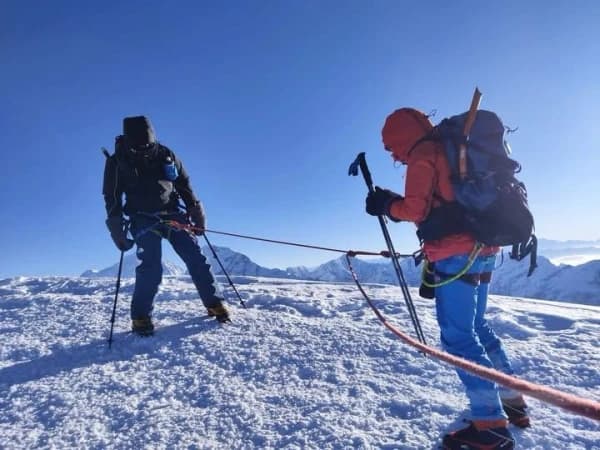
The fixed-rope section is the crux - 40 to 60 degrees on ice and compressed snow, sustained for several rope lengths. Front-point crampon placements, one at a time. The ice axe in the uphill hand. The ascender moving up the rope in deliberate steps. The body above 6,000m is working at its physiological ceiling: breathing is laboured, each step requires full attention, and the cold is in everything. The guide moves the group steadily. No rushing. No stacking up on the ropes. Progress is measured in metres, not minutes.
The fixed ropes end at the summit ridge - narrow, exposed, with the Khumbu spread out on one side and the Imja Valley on the other. The summit marker at 6,189m is a short walk along the ridge. On a clear morning, and October mornings on Island Peak are often clear, the view assembles itself fully: Everest (8,849m) and Lhotse (8,516m) to the north, Makalu (8,485m) to the east, Ama Dablam (6,812m) to the southwest, the full length of the Khumbu glacier below. Summit time from Base Camp: four to eight hours, depending on conditions and the group.
The descent uses the same route. The fixed ropes are reversed with the ascender controlling the pace on the steep sections. Once back on the glacier and below the crampon point, the technical intensity drops. Base Camp arrives, a rest, and then the trail back down to Chhukung. Late afternoon or early evening, typically, after twelve to sixteen hours of continuous output. No dinner tonight - the body needs rest more than food.
What Is the Island Peak Summit Day Like?
Summit day on Island Peak is the reason careful preparation matters. It is a long, physically sustained effort at high altitude on technical terrain, starting in darkness and requiring both physical output and technical focus for 12 or more continuous hours.
Departure (midnight to 2am): The cold at this hour above 5,000m is immediate. Temperatures typically range from minus 10 to minus 20 degrees Celsius, dropping further with wind. The group moves by headlamp across rocky trail before reaching the glacier approach.
Base Camp to High Camp: Approximately 2 to 3 hours. The route climbs steeply through moraine and onto the lower glacier edges. This section is demanding in darkness at altitude - pace control matters more than speed.
High Camp to Crampon Point: Crampons are already on from this stage or are fitted here. The glacier approach begins, and the angle increases as the group moves toward the fixed-rope section. Each step requires deliberate front-point placement on the steeper ice sections.
Fixed-Rope Section to Summit: The steepest and most technically demanding section. Ascending on fixed ropes with an ascender at 40 to 60 degrees on ice and snow, above 5,900m. Breathing is laboured. Rest steps are normal and necessary. The guide manages rope traffic and pacing.
Summit Ridge and Summit: The summit ridge is narrow and exposed. Movement is careful and deliberate. The summit marker at 6,189m is reached - on a clear morning, typically as daylight establishes itself across the Khumbu. The group spends a short time at the summit before beginning descent.
Descent: The fixed ropes are used for controlled descent. The body is tired at this point. Descent requires as much concentration as ascent - particularly on the steep rope sections and the glacier traverse. Base Camp, then Chhukung.
How Difficult Is Island Peak Climbing from Chhukung?
Island Peak is classified as a trekking peak by the Nepal Mountaineering Association, but that classification reflects permit category rather than difficulty. The summit day is a serious high-altitude technical climbing effort. Understanding what that means specifically:
-
Altitude: The summit at 6,189m is above the threshold where altitude significantly affects physical output. Blood oxygen levels at the summit are roughly 60 percent of sea level. Every physical task is harder and every technical mistake has greater consequences.
-
Technical terrain: The fixed-rope section above 5,900m involves 40 to 60-degree ice and snow slope. This is not walking terrain with crampons - it is genuine climbing that requires correct technique, calm movement, and physical strength in the arms and legs simultaneously.
-
Duration: 12 to 16 hours of total output. The summit day is longer than any trekking day on the EBC route. Energy management across the full day - eating and hydrating through cold and altitude-suppressed appetite - is a meaningful challenge.
-
Weather: Weather at 6,000m can shift rapidly. Wind is the primary concern on the summit ridge. The guide monitors conditions and makes go/no-go decisions. A summit attempt that begins in good conditions may encounter deteriorating weather before the summit - this is normal in the high Himalaya and the guide's call in these situations takes precedence.
-
Mental endurance: The hours between midnight and mid-morning on a summit day are physically and psychologically demanding. Darkness, cold, altitude, and sustained technical focus over many hours test mental endurance as much as physical fitness.
Island Peak is harder than Mera Peak (6,476m) in one important dimension: the technical difficulty of the fixed-rope section. Mera Peak involves glacier travel at moderate angles. Island Peak's crux involves sustained steep climbing on fixed ropes above 5,900m. Harder than Mera for most climbers. Easier than peaks such as Lobuche East (6,119m) where the technical terrain is more sustained and the route more complex.
Who Is Island Peak Climbing from Chhukung Suitable For?
This climb is well-suited for:
-
Trekkers who have completed the Everest Base Camp route, Everest Three Passes, or a comparable Khumbu itinerary and arrive at Chhukung already acclimatised
-
People with strong aerobic fitness - walking 6 to 8 hours per day with a loaded pack across multiple consecutive days
-
Anyone comfortable with steep terrain who can move confidently on a slope where a slip has consequences
-
People without prior climbing experience who have adequate fitness, preparation, and willingness to follow guide instruction precisely on the technical sections
-
Experienced trekkers looking for a first 6,000m technical peak objective on a Khumbu itinerary
This climb is not well-suited for:
-
Anyone arriving in Chhukung without adequate prior acclimatisation in the Khumbu region - the three-day programme assumes acclimatisation, it does not provide it
-
People uncomfortable with steep, exposed terrain where movement requires full attention and precise footwork
-
Anyone unwilling to use climbing equipment or follow guide instructions exactly on the fixed-rope section
-
People with uncontrolled cardiovascular conditions - altitude above 5,500m places significant demand on the cardiovascular system
-
Trekkers expecting a straightforward walk to a high point - Island Peak is a technical climb, not a high-altitude trail
Acclimatisation for Island Peak from Chhukung
Chhukung at 4,730m is a meaningful altitude. The body at 4,730m is already producing more red blood cells, breathing faster at rest, and operating with reduced oxygen availability compared to sea level. This adaptation - triggered by nights spent above 3,500m over several days - is the physiological foundation that makes a summit attempt at 6,189m viable rather than reckless.
The standard acclimatisation profile before Island Peak involves: nights at Namche Bazaar (3,440m), an acclimatisation day with a higher hike, nights at Dingboche (4,360m) with a second acclimatisation hike, and the approach to Lobuche (4,940m) or equivalent altitude exposure. Someone who has followed this profile and arrived at Chhukung in good condition - no significant AMS symptoms, normal appetite, reasonable sleep quality - has completed the acclimatisation preparation the Island Peak programme requires.
Signs of AMS (Acute Mountain Sickness) that require attention before attempting the climb: persistent headache not relieved by rest, nausea, loss of coordination, confusion. If any of these are present in Chhukung, the climb does not proceed until symptoms resolve at lower altitude. No summit schedule takes precedence over these signals. The guide assesses the group's condition before committing to the Base Camp approach on Day 2.
HACE (High Altitude Cerebral Edema) and HAPE (High Altitude Pulmonary Edema): Both are serious, life-threatening conditions that can develop rapidly above 4,000m. Immediate descent is the only correct response to either. The guide is trained to recognise the signs and initiate descent without waiting for the team member to self-diagnose.
What Climbing Skills Are Required for Island Peak?
Prior technical climbing experience is not required for Island Peak from Chhukung - but basic physical competence on steep terrain is. The technical skills specific to this route are covered in the Day 2 training session at Base Camp. What that training covers:
-
Crampon walking: French technique (flat-footing) on moderate angles and front-pointing on steeper terrain. The summit slope requires confident front-pointing - the training session introduces this, but the summit day is not the place to be learning it under pressure.
-
Ice axe use: Self-arrest position, plunging technique, and using the axe as a third point of contact on steeper sections. The guide demonstrates and confirms each team member can execute the arrest position before moving onto technical terrain.
-
Harness: Correct fitting, double-back check, and belay loop integrity. The guide checks every harness before the fixed-rope sections.
-
Ascender (jumar) use: Clipping, loading the ascender, stepping up, and moving the device correctly on the rope. This is the primary tool for ascending the fixed-rope section and requires practice before the actual climb.
-
Descent technique: Controlled lowering on fixed ropes, facing in on steeper sections, and managing the ascender for descent. Descending on steep fixed ropes is harder for most people than ascending.
The training session does not create experienced mountaineers. It introduces the specific techniques required for this route under guide supervision. Following the guide's instructions precisely throughout the technical sections is as important as physical fitness on summit day.
Island Peak Climbing Route from Chhukung
The full route progression:
|
Stage |
Altitude |
Terrain |
Notes |
|
Chhukung |
4,730m |
Village / valley floor |
Start point. Well-equipped teahouses. |
|
Island Peak Base Camp |
5,100 to 5,200m |
Rocky moraine, glacier margin |
3 to 4 hours from Chhukung. Tented camp. |
|
High Camp |
Approx. 5,600m |
Glacier approach, steepening terrain |
Midnight departure from Base Camp. 2 to 3 hours. |
|
Crampon Point |
5,800 to 5,900m |
Ice and snow slope begins |
Crampons on (or confirmed on from earlier). Fixed ropes begin. |
|
Imja Glacier / Fixed Ropes |
5,900 to 6,100m |
40 to 60-degree ice and snow |
Technical crux. Ascender on fixed ropes. Guide-led. |
|
Summit Ridge |
6,100 to 6,189m |
Narrow, exposed ridge |
Final approach to summit marker. Exposure on both sides. |
|
Summit - Island Peak (Imja Tse) |
6,189m |
Summit point |
Panoramic view. Brief rest. Descent begins. |
Best Time to Climb Island Peak from Chhukung in 2026/27
Autumn - October to November (Best Season)
October is the most reliable month for Island Peak climbing. Post-monsoon skies are clear, the glacier conditions are stable, and wind on the summit ridge is at its most manageable. Summit day visibility in October is typically excellent, with the full Khumbu panorama visible from the summit ridge on most clear mornings. November remains good but introduces colder overnight temperatures at Base Camp and High Camp - expect minus 15 to minus 25 degrees Celsius at High Camp in November.
Spring - March to May (Good Season)
March and April are the second-best window. Conditions are generally good, the glacier is firm, and visibility is reliable. May sees pre-monsoon afternoon cloud building, which can affect summit-day visibility. Spring departures should plan to summit in the morning before conditions develop.
Monsoon and Winter
June to September is not recommended. Monsoon cloud and precipitation affect route conditions on the glacier and reduce summit visibility significantly. December to February brings extreme cold at High Camp and increased snow instability on the fixed-rope sections. Not suitable for most climbing groups.
Island Peak Climbing Permit 2026/27
Three permits are required for Island Peak climbing from Chhukung. All are arranged by Trekking Guide Team Adventure before your departure:
-
Nepal Mountaineering Association (NMA) Peak Climbing Permit: The primary permit for climbing Island Peak. Set by the NMA and seasonal pricing applies - confirm current 2026/27 fee with Trekking Guide Team Adventure before booking.
-
Sagarmatha National Park Permit: NPR 3,390 per person (approximately USD 25). Required for entry to the national park area covering the Chhukung approach.
-
Khumbu Pasang Lhamu Rural Municipality Local Fee: NPR 3,000 per person (approximately USD 22). Local fee for the Khumbu region.
-
TIMS card: Not required in the Khumbu region in 2026/27.
Island Peak Climbing from Chhukung: Cost 2026/27
The Trekking Guide Team Adventure Island Peak climbing package from Chhukung is priced per person based on group size:
|
Group Size |
Price Per Person (USD) |
|
Solo (1 person) |
USD 875 |
|
2 to 3 persons |
USD 800 per person |
|
4 to 5 persons |
USD 750 per person |
|
6 to 10 persons |
USD 700 per person |
These prices cover the 3-day programme from Chhukung to summit and return. All NMA permit fees, national park fees, and local municipality fees are included. The guide, technical equipment, tented camp, and meals throughout the programme are included. See the included and excluded sections below for the complete breakdown.
What Is Included
-
Pre-Trip Briefing: Meeting and trip briefing with the guide in Chhukung on Day 1.
-
Permits and Taxes: Island Peak (Imja Tse) NMA climbing permit, VAT, service charges, and applicable local taxes.
-
Meals: 2 breakfasts, 1 lunch, and 1 dinner including hot drinks. Day 3 summit food (packed snacks and drinks) included.
-
Accommodation: 1 night in tented camp at Island Peak Base Camp, as per the itinerary.
-
Climbing Guide: Licensed, first-aid-trained, English-speaking NMA-certified climbing guide for all 3 days.
-
Climbing Gear: Quality tents, kitchen equipment, fixed ropes, snow and ice equipment, and other essential climbing gear.
-
First Aid: First-aid kit, pulse oximeter, and staff insurance.
What Is Not Included
-
International Travel and Visa: International airfare and Nepal visa fees.
-
Chhukung Accommodation and Meals: Any accommodation or meals in Chhukung on Day 1, or due to early arrival, delayed departure, or early return.
-
Travel Insurance: Personal travel and medical insurance covering trekking and climbing is mandatory. Must cover helicopter rescue at altitude.
-
Personal Climbing Gear: Individual climbing equipment including mountaineering boots, crampons, ice axe, harness, helmet, and ascender. Gear can be hired in Namche Bazaar or Kathmandu.
-
Porter Services: Porter from Chhukung to Island Peak Base Camp is available at an additional cost.
-
Permits and Fees: Sagarmatha National Park entry permit and Khumbu Pasang Lhamu Rural Municipality fee (NPR 3,000 per person).
-
Gratuities: Tips for guides, porters, and staff are appreciated but not mandatory.
-
Other Expenses: Any services or expenses not specifically mentioned under Cost Includes.
Island Peak Climbing Equipment List
Personal Trekking and Camping Equipment
-
Trekking boots (needed for Base Camp approach on Days 2 and return)
-
Mountaineering boots - rigid sole, compatible with step-in technical crampons
-
Warm layers - base, mid, and insulation layers for minus 20 degrees Celsius overnight
-
Down jacket - essential for Base Camp and High Camp
-
Waterproof shell jacket and trousers
-
Warm gloves with liner gloves - two pairs recommended
-
Balaclava, hat, and neck gaiter
-
UV-blocking sunglasses with side shields - essential above the glacier
-
High-factor sun protection - glacier reflection intensifies UV at altitude
-
Headlamp with spare batteries - summit day departs before dawn; lithium batteries for the cold
-
30 to 40-litre summit pack for climbing day
-
Water bottles or hydration system - insulated to prevent freezing
Technical Climbing Equipment (Bring or Rent in Namche/Kathmandu)
-
Technical crampons - 12-point, compatible with mountaineering boots
-
Ice axe - standard mountaineering ice axe, 60 to 70cm
-
Climbing harness - sit harness with comfortable padding for extended use
-
Helmet - for the fixed-rope section and summit ridge
-
Ascender (jumar) - right or left hand model
-
Locking carabiners - minimum 3
-
Prusik loops - for backup and security
Equipment rental note: Crampons, ice axe, and harness can be rented in Kathmandu (Thamel) and in Namche Bazaar. Mountaineering boots must be purchased or brought from home - rental quality at altitude is unreliable and a poor-fitting boot on summit day is a serious problem. Confirm with Trekking Guide Team Adventure which items the package provides vs which are personal responsibility.
How to Prepare for Island Peak Climbing from Chhukung
The fitness requirement for Island Peak is not the same as the fitness requirement for a Khumbu trek. The summit day demands sustained aerobic and muscular output above 5,000m for 12 or more hours. The preparation that builds this capacity:
-
Long-distance hiking with a loaded pack (6 to 8 hours, 10 to 14kg pack) - the closest available replication of summit-day demand at lower altitude
-
Sustained uphill training: stair climbing with weight, hill repeats, treadmill at maximum incline - the fixed-rope section requires strong quads and calf muscles working at altitude
-
Upper body strength - ascending fixed ropes above 6,000m requires arm and shoulder strength that flat trekking does not build
-
Core strength - stability on steep, uneven terrain in crampons depends partly on core engagement
-
Cardiovascular base - the aerobic demand is high and sustained. Build a base of at least 3 months before the climb
Prior climbing or mountaineering experience is not required. Prior high-altitude trekking above 5,000m is strongly recommended. Anyone who has spent time in the Khumbu above 5,000m and has completed EBC or the Three Passes route is appropriately experienced for this programme.
Accommodation and Food
Accommodation
Day 1 in Chhukung: teahouse accommodation - standard Khumbu teahouse with twin rooms and shared bathroom facilities. Day 2 at Island Peak Base Camp: tented camp, typically single tents or two-person tents depending on group composition. High Camp accommodation on summit-day approach: the group typically reaches High Camp in the early hours of the morning and does not stay overnight - it is a brief rest and preparation point.
Food
Meals at Base Camp are prepared by the expedition support team. The calorie demands at altitude are high, particularly on summit day. A substantial breakfast before the summit attempt and a warm meal on return are standard. High-altitude food is typically simpler than teahouse menus - rice, noodles, soups, eggs, and carbohydrate-dense options. On summit day, the team carries packed food: energy bars, chocolate, nuts, and warm drinks in insulated containers. Hydration management is particularly important above 5,000m - fluid intake should be maintained throughout the summit day regardless of appetite suppression.
Weather and Safety on Island Peak
Island Peak weather follows the broader Khumbu pattern - post-monsoon autumn and pre-monsoon spring are the two stable windows, and within those windows, mornings are typically calmer than afternoons. Most summit attempts depart before dawn to reach the summit by mid-morning before afternoon wind builds on the ridge.
What cannot be predicted in advance: specific wind speed on the summit ridge, fresh snow from overnight precipitation, ice conditions on the fixed-rope section. These are assessed on the ground before and during the climb. The guide holds the decision on whether to proceed through the technical sections. A summit attempt may be modified or abandoned based on conditions observed above the crampon point - this is not a failure of the programme. It is the programme working correctly.
No operator can guarantee a successful summit. Trekking Guide Team Adventure's approach prioritises the safe return of every team member. A guide who turns a group back due to conditions is making the correct call, not the cautious one.
Combining Island Peak with Everest Base Camp or Three Passes
Island Peak from Chhukung is most naturally combined with an Everest Base Camp trek or the Everest Three Passes route. Both itineraries pass through Chhukung and provide the acclimatisation profile that makes the three-day Island Peak programme viable.
-
Everest Base Camp + Island Peak: The EBC route passes through Dingboche, from which Chhukung is an easy side valley extension. After completing EBC and descending to Dingboche, the group moves to Chhukung for Island Peak. A combined itinerary typically runs 18 to 21 days from Kathmandu. See the Everest Base Camp Trek - 15 Days at nepalguidetrekking.com for the approach itinerary.
-
Everest Three Passes + Island Peak: The Three Passes route (Kongma La 5,535m, Cho La 5,420m, Renjo La 5,340m) passes directly through Chhukung via the Kongma La approach. After the Three Passes, a team arriving in Chhukung is exceptionally well-acclimatised for Island Peak. A combined itinerary runs 19 to 22 days from Kathmandu. See the EBC, Cho La Pass and Gokyo Trek - 16 Days for reference.
-
Gokyo + Island Peak: Possible via the Cho La route connecting the Gokyo Valley to Chhukung. The acclimatisation profile from Gokyo (4,790m) and Gokyo Ri (5,357m) supports Island Peak well.
Frequently Asked Questions
How difficult is Island Peak climbing from Chhukung?
Strenuous and technically demanding. The summit day involves sustained high-altitude climbing above 6,000m on a glacier route with a fixed-rope section reaching 40 to 60 degrees. The total summit day runs 12 to 16 hours. Altitude at 6,189m produces significant physiological stress on even fit trekkers. Prior acclimatisation in the Khumbu is essential, not optional.
How many days does Island Peak climbing from Chhukung take?
Three days: Day 1 in Chhukung for briefing and preparation, Day 2 to Island Peak Base Camp with afternoon technical training, Day 3 summit day from Base Camp to Island Peak (6,189m) and full descent to Chhukung. The three days assume the climber arrives at Chhukung already acclimatised from a prior Khumbu itinerary.
How high is Island Peak?
Island Peak, also known as Imja Tse, has a summit elevation of 6,189 metres (20,305 feet). Base Camp sits at approximately 5,100 to 5,200m, and High Camp at approximately 5,600m. The summit is reached after a pre-dawn departure from Base Camp and a 4 to 8-hour ascent depending on conditions and group pace.
Do I need previous climbing experience?
No prior technical climbing experience is required, but strong high-altitude trekking fitness is essential. The Day 2 training session at Base Camp covers crampon technique, ice axe use, harness fitting, and fixed-rope ascending with an ascender. However, this training assumes the climber has the physical and mental baseline to execute these skills under pressure on summit day.
Is Island Peak suitable for beginners?
It depends on the definition of beginner. Island Peak is not suitable for someone without prior experience above 4,000m or someone arriving directly from Kathmandu. It is accessible to a fit trekker who has completed the EBC route or a comparable Khumbu itinerary, has no significant AMS history, and is comfortable with steep terrain. The technical skills can be learned at Base Camp - the altitude and endurance cannot.
How do I get to Chhukung for Island Peak?
The standard approach is the Khumbu trekking route: fly Kathmandu to Lukla (or Ramechhap to Lukla), then trek through Namche Bazaar, Tengboche, Dingboche, and on to Chhukung. The approach from Lukla to Chhukung typically takes 6 to 8 days depending on the acclimatisation schedule. Trekking Guide Team Adventure can arrange a combined Khumbu approach and Island Peak climbing package - contact the team for a combined itinerary.
What is the best month to climb Island Peak?
October is the single best month - post-monsoon stable weather, clear visibility from the summit, and firm glacier conditions on the fixed-rope section. November is also strong but colder. March and April are the best spring options. Avoid the monsoon (June to September) and the winter months (December to February) for standard climbing programmes.
What permits are needed for Island Peak?
Three permits: the NMA Peak Climbing Permit (Island Peak / Imja Tse - confirm current 2026/27 fee with Trekking Guide Team Adventure), the Sagarmatha National Park Permit (NPR 3,390), and the Khumbu Pasang Lhamu local fee (NPR 3,000). TIMS is not required in the Khumbu region in 2026/27. All permits are arranged by Trekking Guide Team Adventure before departure.
Can I combine Island Peak with Everest Base Camp?
Yes - this is the most common combination. The EBC route provides exactly the acclimatisation profile the Island Peak programme requires. After completing EBC and descending to Dingboche, the group moves to Chhukung for the three-day Island Peak programme. A combined EBC and Island Peak itinerary typically runs 18 to 21 days from Kathmandu.
What happens if weather prevents a summit attempt?
The guide assesses conditions before and during the summit day. If conditions above High Camp or on the fixed-rope section are not safe for the group, the attempt is modified or stopped. No itinerary can guarantee a summit. If the summit attempt is not possible due to weather, the programme ends at the highest safe point. Travel insurance covering cancelled activities is recommended.
How fit do I need to be for Island Peak?
The standard fitness test: walk 6 to 8 hours per day with a 10kg pack on consecutive days without significant recovery issues. Upper body strength matters for the fixed-rope section - pull-up and push-up capacity translates directly. Build at least 3 months of consistent training before the climb, including sustained uphill work. Prior high-altitude trekking above 5,000m is the most useful preparation available.
Ready to Climb Island Peak from Chhukung?
The Island Peak programme from Chhukung is designed for trekkers who are already in the Khumbu and ready to take a summit objective. If you are planning an Everest Base Camp trek, a Three Passes itinerary, or have already completed a Khumbu route and want to return with a climbing focus, Trekking Guide Team Adventure can build the complete combined package.
Discuss your trekking background, timeline, and fitness level with the team. We confirm whether the Island Peak programme is the right fit for where you are in your Khumbu itinerary, advise on equipment, and handle all permits before you reach Lukla.